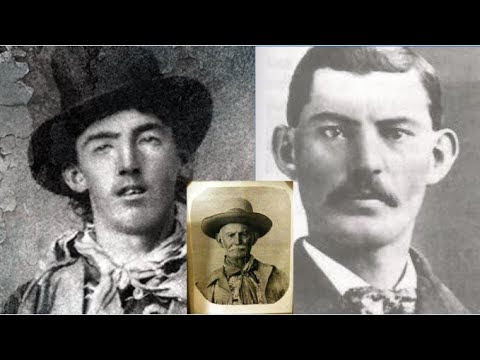
Brushy Bill Roberts:
The Man Who Claimed To Be Billy The Kid
Wild West outlaw Billy the Kid died in 1881 — or did he escape, vanish, and live on under the name Brushy Bill Roberts in Texas all the way until 1950?


Discussing America's wilderness, the environment, wildlife, conservation, sled dogs and a little bit of politics
To answer that question, The Times interviewed groups of young New Yorkers. About a dozen of them agreed to document their daily lives by making videos on their ubiquitous smartphones. Others tolerated us while we shadowed them and asked annoying questions. Here’s what they gave us.


"I was asked recently if Parkinson's ruined my life . . . it hasn't. It hasn't ruined my life. i guess its just changed it a bit. I still feel like the same person and for now, I'll take that as a win." - film maker Brett Harvey
MY LIFE WITH PARKINSON'S
As April is Parkinson's Awareness Month, I felt it was an appropriate time to "come out" so to speak and write about my life so far as a "Parkie".
Overview
 Realizing that Parkinson’s
disease is first and foremost a movement disorder there are, however, so many
complexities involved that it goes way beyond such a simple description, to the
point that its many symptoms is often classified as a “designer disease”. There are
an estimated 1 million people in the U.S. living with Parkinson’s disease and
more than 8 million people worldwide. The average age of those diagnosed with
PD is 60. I was 62 however and evidently have had symptoms since my late 40’s.
Symptoms which I just recently recognize as having been red flag indicators
that I had foolishly written off as a function of age.
Realizing that Parkinson’s
disease is first and foremost a movement disorder there are, however, so many
complexities involved that it goes way beyond such a simple description, to the
point that its many symptoms is often classified as a “designer disease”. There are
an estimated 1 million people in the U.S. living with Parkinson’s disease and
more than 8 million people worldwide. The average age of those diagnosed with
PD is 60. I was 62 however and evidently have had symptoms since my late 40’s.
Symptoms which I just recently recognize as having been red flag indicators
that I had foolishly written off as a function of age.
There
is no single test or scan for Parkinson’s, but there are three significant
symptoms that help doctors make a diagnosis:
1. Bradykinesia - meaning slowness of
movement. It is one of the cardinal symptoms of Parkinson’s. (Bradykinesia plus
either tremor or rigidity must be present for a PD diagnosis to be
considered).
2. Tremor - Characteristically
occurring at rest, the classic slow, rhythmic tremor of Parkinson’s disease
typically starts in one hand, foot, or leg and eventually affects both sides of
the body.
3. Rigidity - refers to a
tightness or stiffness of the limbs or torso.
My tremors were first noticed in my early fifties when the twitching started with my left-hand thumb and index finger. They have progressed within the last two years to the right hand and leg. It is troublesome when using a computer mouse or when drinking a cup of coffee becomes challenging. Eating with a fork is quite an event as well. Sometimes it is difficult keeping the food where it needs to be. Too often some of my meal ends up either in my lap or on the floor . . . it’s a good thing we have a dog.
Late 2019 was the point in time when my Parkinson’s disease notably revealed itself. Up to that point, there were a few indications which only now have I come to recognize were red warning flags of PD. Parkinson’s disease is called a designer disease primarily because no two ‘parkies’ share the same symptoms. Ever the overachiever, I have so many of them, not all of which are typical, but I do have all three of the cardinal indicators of PD!
Resting Tremors: For many years, my left thumb and index finger would twitch. I was mistakenly told by several doctors not to worry about it as essential tremors are not unusual. This was without any actual type of clinical assessment being performed or medication prescribed. It was not until, during a routine physical, our family primary care physician questioned the twitching, conducted a couple of clinical tests and recommended that I see a neurologist. The rest, as they say, is history.
Bradykinesia: the saying is that hindsight is 20/20 and I only now have I been able to recognize the subtle hints of the earliest manifestation of the disease.
For many years I had been a wildland
firefighter. Each year I was required by the forest service to take a “pack
test” which consisted of walking three miles in forty-five minutes carrying a
forty-five-pound pack. I knew my walking pace was slowing down after just
barely passing my very last one. My 2015 test came in at forty-four
minutes-forty-five seconds. Prior to that my test times were for many years,
usually much closer to 40 minutes. I recall during this test a forest patrolman
gave me some on-the-fly coaching which, in hindsight, was revealing . . .
telling me as I passed through the check-point he was monitoring to “Swing your
arms. You’re not auditioning for the walking dead!”. What I do know now is that
lack of arm swing is a PD indicator and there was and is a definite reduction in my right
arm swing. I feel as if my arms and legs are weaker and that there is
considerable pain when I try to perform what had always been a routine task . .
. something as simple as putting on a pair of jeans or sneakers. I also no
longer have the typical “New Yorker’s stride”. My walking pace has slowed
considerably, especially when I am not moving on a flat, level surface.
Rigidity: during my college years I played middle infield and was known to have what was commonly referred to as a “shotgun arm” (In baseball jargon, “shotgun” refers to a powerful throwing arm). Several years ago, I discovered that I was no longer able to throw a baseball with the same velocity or coming anywhere close to the distance I was used to. Granted, my age would probably account for some reduction in speed and distance, however the difference was obvious. Rigidity, especially in the early, undetected stages of the disease, was incorrectly attributed to a rotator cuff injury when the issue was actually determined to be what is known as “frozen shoulder” (a common musculoskeletal disease of idiopathic Parkinson’s disease that causes long-term pain and physical disability). Physical therapy was prescribed with zero benefit. Currently I experience stiffness including both muscle and joint pain throughout much of my body. It is particularly noticeable in my legs, right arm, fingers, and hands – all of which no longer seem to work properly. The pain and stiffness associated with my Parkinson’s was affecting muscles and joints, which were in the absence of any real physical injury.
Movement Disorders
The issues I have in
controlling what had always been normal, unconscious movements are as
troublesome as they are inconvenient. I regularly encounter the following:
o Smaller steps, slower speed.
o A narrow base of support, meaning my feet
remain too close together when initiating a step.
o Absent arm swing on the right side of
my body.
o Extreme difficulty pivoting and/or
turning.
o My feet tend to land flat on the floor with each step instead of on the heel, leading to shuffling and falls.
o Festination or shuffling - quick,
small, involuntary steps forward.
o Retropulsion - quick, small,
involuntary steps backward – usually only when exiting our personal vehicle.
Freezing of Gait: This was the issue that prompted an appointment
with a neurologist. The temporary, inability to move, seems to happen at any
time, though it tends more often to occur when initiating a step, turning and
navigating through doorways or narrow passageways. I fully agree with what has often
been described as feeling as though one’s feet are glued to the floor. It can be
particularly embarrassing in a public situation but has the potential to be a
more serious problem, as it has resulted in numerous incidents of falling. It feels as
if my body is not obeying my brain's commands which I find it to be extremely
frustrating.
Dystonia of the foot: Dystonia is a symptom of Parkinson's disease which is also a movement disorder on its own, marking painful, prolonged muscle contractions causing abnormal movements and postures. Experts estimate that more than 30 percent of people living with Parkinson's disease may experience dystonia as a symptom or as a complication of treatment (dystonia can occur when medication is wearing off). In my case, a painful cramped foot is the telltale sign of dystonia. My right foot feels fine when sitting but develops foot inversion (turning in of the foot or ankle) when trying to walk or stand. Small steps and twisting makes initiating a step awkward and results in “start hesitation”.
Non-Motor Symptoms
“Although Parkinson’s disease is primarily considered a motor disorder, several studies have shown non-motor symptoms are common across all stages of the disease, however, these symptoms are often undiagnosed because patients are unaware of the link to the disease and, as a result, they may be under-treated.”
Sleep disturbance: Insomnia - I generally have no problem falling asleep. The difficulty in my case is remaining asleep. I only average 6.25 hours per night. 20mg of melatonin helps to occasionally achieve an additional hour or two. I do not suffer from rapid eye movement sleep behavior disorder or restless leg syndrome . . . two sleep disorders that can affect those with PD.
Breathing Issues: Although James Parkinson, in 1817, described breathing abnormalities in
his “Essay on the Shaking Palsy”, there has been limited research on this
important non-motor symptom. I have had shortness of breath since late 2016. I’ve taken numerous tests
- chest x-rays, echocardiogram, spirometry, and of course every allergy test
known to modern medicine, all of which came back with the same result: negative
pathology. I was initially diagnosed with asthma, but the allergy specialist is
now 99.9% certain my breathing disorder is a result of PD.
An interesting read for an issue that affects me and many others with PD: http://www.outthinkingparkinsons.com/articles/breathing-disorders
Vocal chords and swallowing muscles: PD dystonia causes my voice to slur, and at times sound softened,
hoarse or breathy during certain parts of the day or in high stress situations.
Originally, I thought that my hoarseness was due to extremely low humidity . .
. until I was diagnosed with PD.
Effects on Vision. I have
had a variety of complaints related to my vision such as trouble focusing at
close range, but more frequently dry, irritated eyes which is followed by extreme
tearing. People with Parkinson's can experience this for several
reasons, including decreased blinking due to impaired reflexes. Infrequent
blinking can
cause dry eyes which stimulates the lacrimal (tear) gland resulting in
excessive watering.
More: https://www.michaeljfox.org/news/ask-md-vision-and-parkinsons-disease
Micrographia (small handwriting): A non-motor symptom. Within the past two
years, I have noticed that my handwriting has become exceptionally small
and illegible. Actual note taking with a pen or pencil is now practically useless
and my signature has gone from normal to what has become basically just a
squiggly line. I am sure that the nuns who taught me cursive writing would be
apoplectic.
Stress,
Depression and the Effects of Cognitive Changes Fortunately, I am still unaffected
by depression or cognitive changes. My neurologist believes that I am not
really a candidate for Parkinson’s dementia . . . although I have no clue as to
what he uses to base that opinion.
Stress is known to be a challenging, but modifiable risk factor for Parkinson’s disease progression. Research suggests that stress events may be a factor which aggravates and intensifies the symptoms of PD. Studies indicate that stress damages dopamine cells, resulting in more severe parkinsonian symptoms. The findings suggest that programs that provide stress reduction tactics may be an effective intervention in the disease.
At this point I have no clinical
signs of depression although I admit to having been very frustrated on occasion
by my inability to do those things I had been able to do for the prior 60 plus
years, albeit briefly. I do remain positive about where I am in life, regardless
of the situation. As Winston Churchill said “attitude is a little thing that
makes a big difference. Fortunately, I am to married to a true angel who has
been my caregiver and has provided such tremendous, loving support.
Thankfully, at this stage of the game I have no cognitive issues other than occasionally trying to remember a name of a casual acquaintance or fumbling a bit to find just the right word. Every evening I will do word puzzles which I believe help me to remain relatively sharp and for most of my life I have been a voracious reader. In addition, I am also involved with a computer simulation that requires highly complex mathematical calculations.
The Five Stages Of Parkinson’s Disease
Parkinson’s disease impacts people
in different and unique ways. Not everyone will experience all the symptoms of
Parkinson’s, and if they do, they will not necessarily experience them in quite
the same order or at the same intensity. There are typical patterns of
progression in Parkinson’s disease that are defined in stages. I am amazed by
how long I lived with stage one and how many years it took to develop into
stage two and how quickly it advanced to stage three . . . I believe that the
symptoms indicating a faster progression of change began in 2015 and lasted
through early 2020, when the freezing of gate was first apparent.
The
change from two to three was even more rapid in that within a few months I had seemingly ‘progressed’
a stage. My neurologist puts me at mid-stage, which I might agree with to some
extent. My guess, based on the descriptions of each of the five stages, is that
I am at a late stage two or early stage three. I have read that it is possible,
with the right guidance, exercise and changes in lifestyle, to drop back a
stage. That is my ultimate goal.
Stage
One During this initial stage, the person has mild symptoms
that generally do not interfere with daily activities. Tremor and other movement symptoms occur
on one side of the body only. Changes in posture, walking and facial expressions occur.
Stage 1 constitutes the mildest form of Parkinson’s disease. During the stage
1, the patients may experience symptoms, but the mild ones and do not interrupt
daily tasks or one’s lifestyle. In fact, symptoms during the first stage are so
mild that both doctors and patients often missed. However, the family members
and the friends may observe changes in the way you walk, your body posture or
your facial expressions. Tremors at a specific side of one’s body are the
distinct symptom associated with stage 1 of Parkinson’s disease. In this case,
the doctors give prescribed medicines, which work in an effective way to reduce
the symptoms and allow individuals to lead a normal life.
Wow . . . two years since my last blog post. Time sure does fly. No excuses actually, I was just pretty well wrapped up in my career and other personal adventures.
Needless to say, a tremendous amount of ‘stuff’ has obviously
happened since 2018 – from a lying, narcissistic, incompetent idiot in the White
House (who fortunately was told to GTFO during the November election) to the devastation wrought by the coronavirus pandemic, a disease that has
brought the world to its collective knees. Like the events of September 11th, I’m sure and I fear that life as we
knew it will be dramatically changed. Hopefully, in time we will be able to recover
and return to some semblance of normalcy.
And then there are the personal
changes that have had a major impact on my life. I spent most of the summer on
2018 fighting massive western wildfires and then assisting in the recovery
effort. 2019 was, for the most part, routine and basically uneventful. 2020 however
was personally, another story.
We are currently witnessing the
terrible effects of the COVID 19 pandemic and the horrible impact it has had on
so many people. As of this writing over 500 thousand Americans have died. I
have been fortunate in that in my position, I was considered ‘essential’ so thankfully,
I remained fully employed. I’ve also practiced the necessary safeguards of mask
wearing, social distancing and staying sequestered from the rest of the world which
has, so far, kept me virus free.
But my health still took a major
hit this year. In February of 2020, I was diagnosed with Parkinson’s disease . . . and
not just PD, an ADVANCED stage of Parkinson’s! How could this have happened? In
my entire adult life, other than the occasional cold here and there, I had
always been the picture of health. I was incredulous . . . until I looked back
at those subtle, missed signs.
The muscle stiffness, the
microscopic penmanship, and the lack of arm swing were overlooked warning signs
which are also early tell-tale symptoms of PD.
The twitching finger on my left hand was probably the big one which should have raised a red flag. I ignored it but so did the many doctors who, when asked during routine physicals, wrote the issue off to ‘essential tremors’ . . . which are not uncommon.
So there it is . . . my disability: a progressive, incurable neurodegenerative disease that affects millions worldwide. I can deal with the tremors and the other stuff but it is the 'freezing of gait' that is my biggest challenge.
What exactly is Freezing of Gait (aka FOG)? Well, plain and simple it is when my brain tells my feet to go forward but my feet say "nope . . . not gonna do it" and I'm left with the sensation of my feet being glued to the floor. The problem, actually the danger, is that while my feet may not move, the rest of my body didn't get the memo and actually tries to move forward, expecting to take a step which doesn't come. This can result in a fall . . . which I have done more times than I'd like to say.
The most common forms of freezing are seen with initiating gait (start hesitation) and during turning. Freezing may also be caused by the presence of a visible obstacle in the path, a change in the pattern of design on the floor, walking in narrow spaces or crowds, or being rushed or startled
TO BE CONTINUED . . . .

 It is no secret that some state legislators in the West want to boot federal land management agencies from their states. They argue that agencies like the Bureau of Land Management and Forest Service cost too much and are too detached from local values, and that states could make money by running our vast open spaces like a privately owned business.

.jpg)
